The development of food trends

The development of food trends

Our eating habits can give us a little insight into our lifestyle. But how does the longing for relaxation, slowing down and enjoyment affect the current (home office) situation? How can we combine our desire for healthy eating and enjoyment? And how is our view of product origin and packaging solutions changing in conjunction with sustainability?
08.03.2024
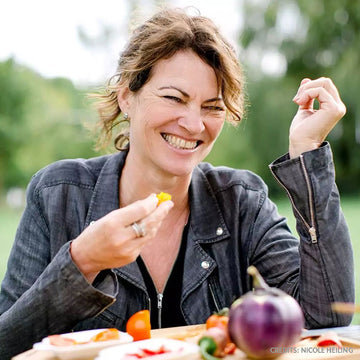
Eine Frau lacht, hält Essen in einem Park, mit Gemüse auf einem Tisch.

Interview with Hanni Rützler

We asked ourselves a few questions about the current development of food trends and general eating behavior - and found the answers from nutritionist and health psychologist Hanni Rützler. Find out more in our exciting interview with the food trend expert!

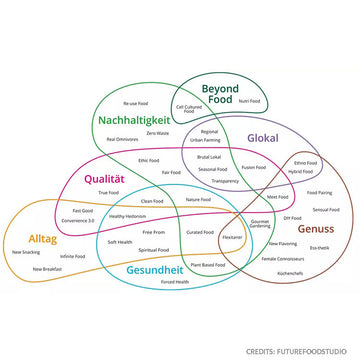
Diagramm zeigt überlappende Kreise mit Lebensmitteltrends, verknüpft durch Begriffe wie Nachhaltigkeit und Genuss.

What food trend developments can we expect?

In the wake of corona, some food trends are losing importance, while others are gaining new momentum as a result of the crisis. The winners include almost all food trends within the health cluster, including trends such as plant-based food, fair food and brutal local. On the other hand, developments towards snackification and trends such as Meet Food, which expresses the need of many people to get "closer to the product" again, to not only "consume" food, but to be able to experience it sensually - also through contact with producers - have lost momentum. The social distancing requirement has put a few obstacles in the way of this trend development - at least in the short term

"You are what you eat" - are our personality and our eating behavior really closely linked and how will this manifest itself in the future?

In the last 30 years, the abundance and wide range of products on offer have put more and more people in the comfortable position of being able to make theirown individual eating decisions, independent of family and social traditions and customs. They are increasingly choosing their food according totheir lifestyle, i.e. how they see the world and how they see themselves in it. Sociologist Günther Hirschfelder is even convinced that eating styles are increasinglytaking the place of lifestyles. This gives real meaning to the motto "You are what you eat" or - even more precisely today in view of the numerous eating styles that exclude certain foods (vegan, gluten- or lactose-free, paleo etc.) - "You are what you don't eat".
Even in a crisis, eating behavior remains an expression of one's own values and therefore remains intact; if you are not confronted with financial hardship, it tends to come to a head. Of course, at the moment you can almost only communicate your lifestyle virtually - through social media channels.