Unsweetened pineapple: So fair. So good.

Unsweetened pineapple: So fair. So good.

Juicy, sweet and fair - that's the new Fairtrade pineapple from Seeberger. An exotic snack with no added sugar that not only impresses with its natural taste, but also with its sustainable origin and fair production conditions. We show you how our pineapple is harvested and processed locally by our partners in Ghana before the delicious pieces end up in our packaging.
18.07.2024
Reading time: 5 minutes
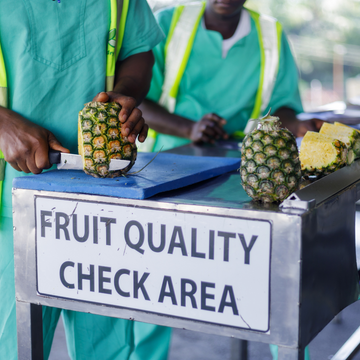
Ananas wird auf Schneidebrett geschnitten, kontrolliert von Personen in Fruchtkontrollbereich.

What makes our pineapple so fair & so good
Sustainability in cultivation practice:

  • No artificial irrigation required for cultivation
  • Short distances between fields and processing factory, lower CO2 footprint
  • Cultivation to harvest takes approx. 14 months

Resource-saving processing & circular economy

  • Pineapple cleaning with treated rainwater
  • 25% of the electricity and 95% of the heat required for drying ovens from our own biomass production
  • Non-recyclable peel parts are used as fuel
  • Strictly controlled quality standards for the products
  • Pineapple peel composting as fertilizer for the fields
  • Processing the stalk into pineapple flour

Social responsibility

  • Support for local small farmers with 1-3 hectares of land
  • Added value and job guarantee through purchase guarantee from Seeberger
  • Transportation and meals during working hours for employees
  • Company-owned kindergartens and preschools
  • Further training opportunities in various areas, including cooperation with universities and special support programs
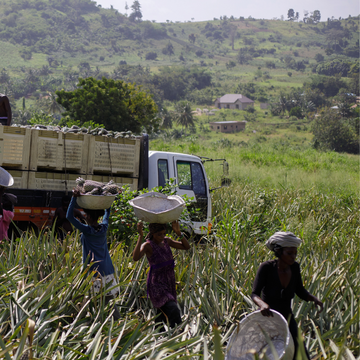
Frauen tragen Körbe mit Ananas zu einem Lastwagen auf einem Feldweg.

Sustainability in cultivation practice - from the field to the fruit
Our pineapple comes from the sun-drenched plantations of Ghana. The fruit grows there under ideal climatic conditions. Without artificial irrigation and using rainwater and biomass, our local partners rely on environmentally friendly cultivation methods.

A sustainable cycle

Thanks to the tropical climate and nutrient-rich soil, pineapples thrive under ideal conditions in the sunny fields of Ghana. The use of rainwater means that there is no need for artificial irrigation during the cultivation process, which lasts 14 months. During this time, the fruit can ripen and develop its full sweetness. Once the ripening process is complete, the fruit is harvested and transported. We attach great importance to short transportation routes between the fields and the processing factory. This not only reduces the CO2 footprint, but also ensures that the fruit can be processed fresh and in the best quality.

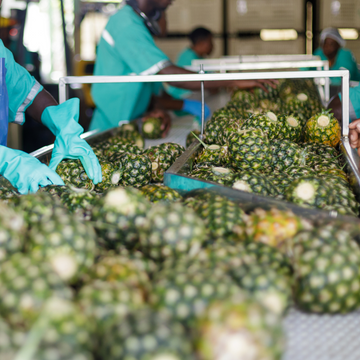
Ananasfrüchte werden von Personen in blauen Handschuhen auf einem Förderband sortiert.

Resource-saving processing: every drop counts
The processing methods on site have been optimized so that every resource can be ideally (re)used. Treated rainwater is used to clean the pineapples in order to conserve valuable water resources. The outside is also important - the pineapple peel residues are fermented into biogas, which is used to generate electricity and heat. In fact, this can cover 25% of the electricity requirements and 95% of the heat requirements of the drying ovens. The non-recyclable parts of the shells are also put to good use as fuel. This enables us to keep the environmental impact as low as possible while maximizing the efficiency of the production processes.

Everything is used

Our pineapple is subject to strict quality controls to ensure that only the best ends up in the bag. But what happens to the rest? Every pineapple is fully utilized so that nothing is wasted - from the fruit to the peel. The pineapple peel is composted and returned to the fields as a natural fertilizer, making the soil more fertile and thus supporting the next harvest. The inner values also count - the hard stalk of the pineapple is processed into pineapple flour, which can be used as a release agent in food production. This form of circular economy not only promotes sustainability, but also supports small local farmers who cultivate between one and three hectares of land.

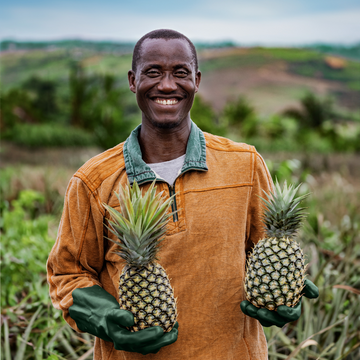
Ein Mann hält zwei Ananas, lächelnd auf einem Feld mit grünem Hintergrund.

Social responsibility: more than just a workplace

At Seeberger, we go beyond pure product quality and want to take responsibility for the people who grow and process our pineapples. By guaranteeing long-term purchase quantities, we offer local farmers and their families a secure, stable livelihood and predictability for the coming years. We also ensure fair working conditions. Employees are provided with transportation to work and free meals during their working hours. We not only support the compatibility of work and family life at our company headquarters in Ulm, but also offer our employees in Ghana in-house kindergartens and preschools. In addition to work and family, the topic of education is also to be further strengthened for our local partners. In cooperation with local universities and special support programs, we can create career prospects and additional training opportunities in various areas for our employees.

Our new unsweetened Fairtrade pineapple is more than just a snack - it is a real piece of sustainability and social responsibility. The sweet and fruity pieces bring exoticism to the bag and at the same time offer the assurance that they have been produced sustainably and responsibly. See for yourself - click here to go to the product!