The best supporting role in snack heaven: pecans

The best supporting role in snack heaven: pecans

What do pecans and walnuts have in common, apart from the fact that they both belong in your mouth and not on your eyes? A lot more than you might think. The pecan, known as the "sweet sister of the walnut", has a history that is at least as crunchy as our crunchiest nut mix. Want to get to know the new deliciously sweet nuttiness? Let's visit it - preferably directly where it comes from.
Image of Anna Moscagiuri
Anna Moscagiuri
19.04.2024
Reading time: 5 minutes
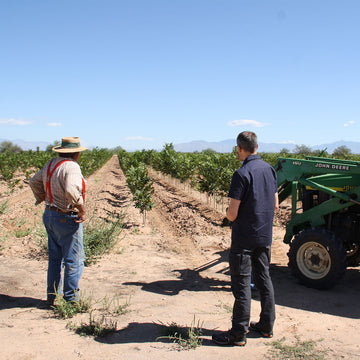
Zwei Männer begutachten Feld mit jungen Bäumen, neben einem John Deere Traktor.

Start in the sea of shimmering heat

Arizona is known for its giant cacti and the imposing Grand Canyon. The US state is not only a paradise for hot Instagram photos, but also the glowing home of our pecan. The brooding landscape takes your breath away as vast, open plains lean against dramatic mountain ranges full of untouched wilderness. The wildlife there is also spectacular - it brings together exotic species that love extreme conditions and barren habitats. Gila lizards, desert horned vipers and majestic desert buzzards, for example, feel right at home here.

Icon of resistance

Those who know it will not be surprised that the pecan tree also drives its deep roots into this dusty soil - just as it stretches upwards into the sun: the pecan tree grows between 30 and 50 meters high, the trunk has a stately diameter of up to two meters. You also have to look twice at its age: It can live for up to 1,000 years, believe it or not. And although it is at home in the desert heat, it can withstand temperatures as low as -20 degrees. Clearly, this tree is a testament to the indomitable adaptability of nature. Its root system, highly efficient use of water and resistance to heat make it tough enough to thrive in a merciless world - for centuries.

The strategy of survival

Robust seeds ensure that the next generations can also start in the harshest of environments. To make this work, the tree uses a sophisticated system: it bears male and female flowers, but they do not bloom at the same time. This ensures a diverse genetic material. For pollination, at least two trees must stand next to each other. The tree is not dependent on insects, as the pollen is spread by the wind.

A culinary family reunion

Botanically, the pecan belongs to the walnut family, which is why these nuts are often in competition with each other. No wonder, because they really do look like they are carved from the same wood, and in terms of flavor, they are also in the same league: the similar composition of aromatic substances, the comparable fatty acid pattern and an almost identical texture make them clear cousins. However, while walnuts leave a bitternutty mouthfeel, pecans have a milder sweetness, which can even turn caramel-vanilla after roasting. Walnuts, on the other hand, retain their robust, earthy aroma even after roasting.


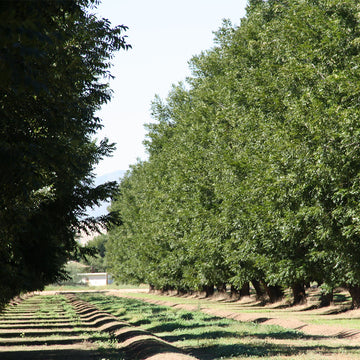
Reihen von dicht belaubten Bäumen stehen in ordentlich angelegten Linien auf einer Plantage.

Shaker, Raker, Harvester

The ripening process follows a two-year cycle, which means that the full harvest only takes place every two years. When it is time, it starts at the end of November and lasts until January. As is usual with nut harvests, pecan trees are gently shaken by a so-called "shaker", causing the nuts to fall to the ground. Then comes the "raker": a sweeper that sweeps the nuts together on the ground. Then the "harvester" finishes the field work: it collects the pecans from the ground and bundles them for further processing.

Precise processes

Once they arrive at the factory, the first step is to remove branches, leaves and stones from the nuts and clean them with cold water. The nuts are broken open in a so-called "cracker", whereby we take great care to ensure that the kernel remains undamaged - no easy task. Thanks to state-of-the-art technology in the form of metal detectors and infrared scanners, our nuts undergo strict quality controls. We then separate them neatly into "pieces" and "halves" - at Seeberger, we only use the latter.

Temptation XXL

When it comes to pecans, all size categories sound like king size: there are Jumbo Halves, Junior Mammoth Halves and Mammoth Halves. The Seeberger bags contain the particularly large nuts - the Junior Mammoth and Mammoth Halves. After the final drying and the final quality check, they are vacuum-packed so that the crunch doesn't go to waste.

Sustainable and fair trade

Soil, water, transportation - food production is inherently energy and resource intensive. To make up for this, we follow a consistently sustainable approach. For the production of our pecans, this means

  • The shells of the pecan kernels become compost for the plantations and thus go straight back to the start.
  • While plantations are usually "flooded" with some irrigation methods, our partner uses so-called "micro-sprinklers". With this system, the water reaches the tree roots directly in the soil with virtually no waste.
  • When transporting the pecans, we completely avoid air transport and prefer to transport them by sea.
  • As part of our zero-waste claim, we pack the pecans in vacuum packaging during transportation by sea, because we can't stand food waste.
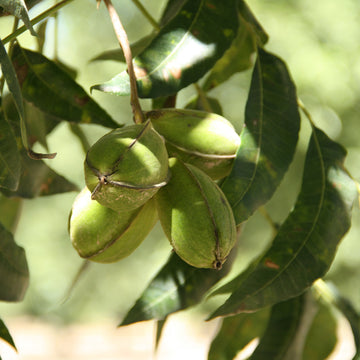
Grüne Pekannüsse hängen an einem Zweig, umgeben von langen, dunkelgrünen Blättern.

Your grandiose pleasure with good knowledge

You are what you eat. So it's only logical for us to show you how and where your snacks are made. But enough talk, where are the stars? Grab your choice walnuts from the most spectacular landscapes and taste the chilled side of Chile. Guaranteed from a good home and raised with love. <3