Tongue tingling cranberry: your vitamins on the red carpet

Tongue tingling cranberry: your vitamins on the red carpet

It's early fall, you're on the road in Canada. You discover a lake in a wide open space, in front of it a strange red landscape, roughly grained like a freshly made tennis court. You head towards the lake and realize at the last second that you'd better not step onto the red surface. What's going on here?

Image of Anna Moscagiuri
Anna Moscagiuri
18.04.2024
Reading time: 5 minutes

Water feature in a class of its own

You take a closer look at the red and discover: The lake starts right here! You didn't notice because the water is overflowing with ... little red balls dancing on the surface. Are you in bubble tea heaven? No, you're in the middle of a spectacular spectacle that is ingeniously simple and yet incredibly elaborate.

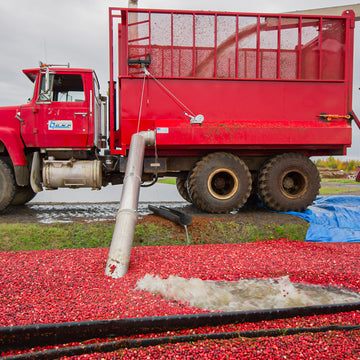
Ein roter Lastwagen pumpt Wasser und Cranberries auf eine Plantage am Feldrand.

Harvest professionals in action

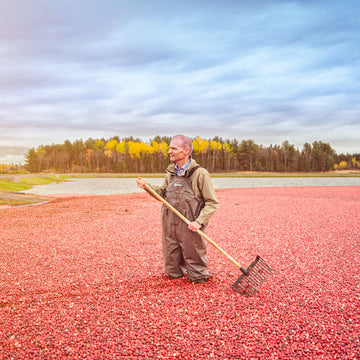
You take in the scene: Further back in the water, men with full-body rubber suits and rakes wade through the red soup and sweep the balls in one direction . What now looks more like a crime scene clean-up is actually the sophisticated harvesting of a squeaky-sour fruit called a cranberry. It floats in water by the millions because the field where it grows is completely flooded shortly before harvesting. This is the easiest way to get them off their knee-high bush.

Physics takes over

Cranberry fields are always located near large water reservoirs. The start of the harvest is often just a flap opening so that the dammed water can shoot onto the neighboring fields. From now on, physics is the best harvest helper: as soon as the bushes are under water, the ripe cranberries push to the surface and form an impressive carpet. The berries float because four air-filled hollow chambers inside give them buoyancy and make them easy prey for the farmers: they are already in position for the big extraction.

Kranbeeren schwimmen auf Wasserfläche, Arbeiter treibt sie zusammen, umgeben von Wald und Himmel.

Swing with caution

Help is provided to ensure that as many berries as possible are detached from the bushes: Either with a whirlpool or special vehicles that plow through the water and cause the plants to vibrate. They have to be careful when doing this: The buds for the next generation of cranberries are already ripening on the bushes and must not be damaged under any circumstances.

Old name, new frame

When the buds open in spring, the shape of the flowers is reminiscent of a crane's beak. The first German and Dutch settlers in North America noticed this, which is why the fruits quickly became known as "cranberries". English turned them into the trendy "cranberries" - paving the way for their triumphal march around the world. Their "second name" is less well known. In Germany at least, it is sometimes called the "cranberry". This is due to its favorite environment: it grows particularly well in forests, moors and heaths. The cranberry fields in North America are also traditionally called "bogs" - the English word for swamps and moors.

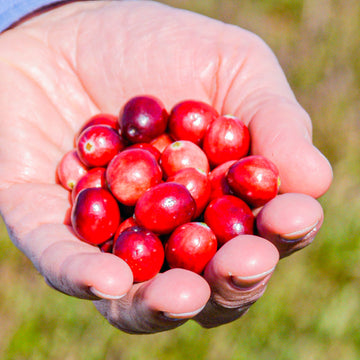
Eine Hand hält rote Cranberries in einer hellen, natürlichen Umgebung.

Red, round, ready to roll

Back in the curious ball pool: a floating belt surrounds the berries dancing in the water and pushes them closer and closer together piece by piece. They are to be pushed to the large suction pipe, which pumps them by the ton onto the loading areas of the waiting trucks. There they are given their first shower on the spot before being transported to the surrounding plants. Once the red carpet has been harvested, the plantation water floods the next field via canals and pipes. This creates a resource cycle that combines efficiency with economy.

Next Level Cranberry

At the factory, they are first sorted according to size and ripeness. For those that pass this check, it's time to move on to the flavor preparation. Because pure cranberries are so sour that they would give most people a pretty harsh acid kick - you have to like them. To make the most of these fruity nutrient bombs, we have come up with a juicy solution. There's pressure to start with.

The freshness shock with a sweet twist

The first step is through the press, where they lose almost half of their juice. Cranberries, which are later sold halved, are also cut here. While the whole and halved berries wait for the next step, the pressed juice is mixed with sugar. This is because the cranberries should get their juice back, but with a slightly more pleasant taste. They are therefore returned to the sugared and heated juice so that what belongs together quickly comes together again. They are then placed in a drying tunnel and bid farewell to their Canadian homeland in circulating hot air: soon they will be packed and on their way to us in Ulm.


Ein Mann bearbeitet ein Cranberry-Feld mit einem Rechen an einem bewölkten Tag.

One and a half decade

We have been cultivating our partnerships with cranberry producers in eastern Canada for over 15 years. The region is one of the world's best growing areas for this popular superfood and has a centuries-old tradition with these little sour wonders. We are therefore doubly proud of our solid partnerships with many local farmers. One condition for us is that our producers share one thing with us: The great vision of a world in which people and the environment are in perfect harmony. Our partners show that this is the case in their daily work: for example, they are developing ever more sophisticated techniques to use fewer resources and to steer the impact of their work in a positive direction. That's why we say: Yes, we Cranberry!

Your grandiose pleasure with good knowledge

You are what you eat. So it's only logical for us to show you how and where your snacks are made. But enough talk, where are the stars? Grab your velvety-sweet figs from the Turkish sun. Guaranteed from a good home and grown with love. <3